

Imagine the 100,000 CIOs of the largest companies in America all came together.
Each of them knows things the others don’t know. One knows an obscure API. Another knows a strange workaround. Someone knows where a particular piece of data sits. Someone else knows that two systems which shouldn’t really talk to each other actually do.
Normally, that knowledge is distributed.
Now imagine all 100,000 CIOs could instantly share what they know with each other. One person discovers A. Another person has B. Someone realizes that A + B leads to C. Another person tests C and discovers D.
Very quickly, what one person knows becomes what everybody can use.
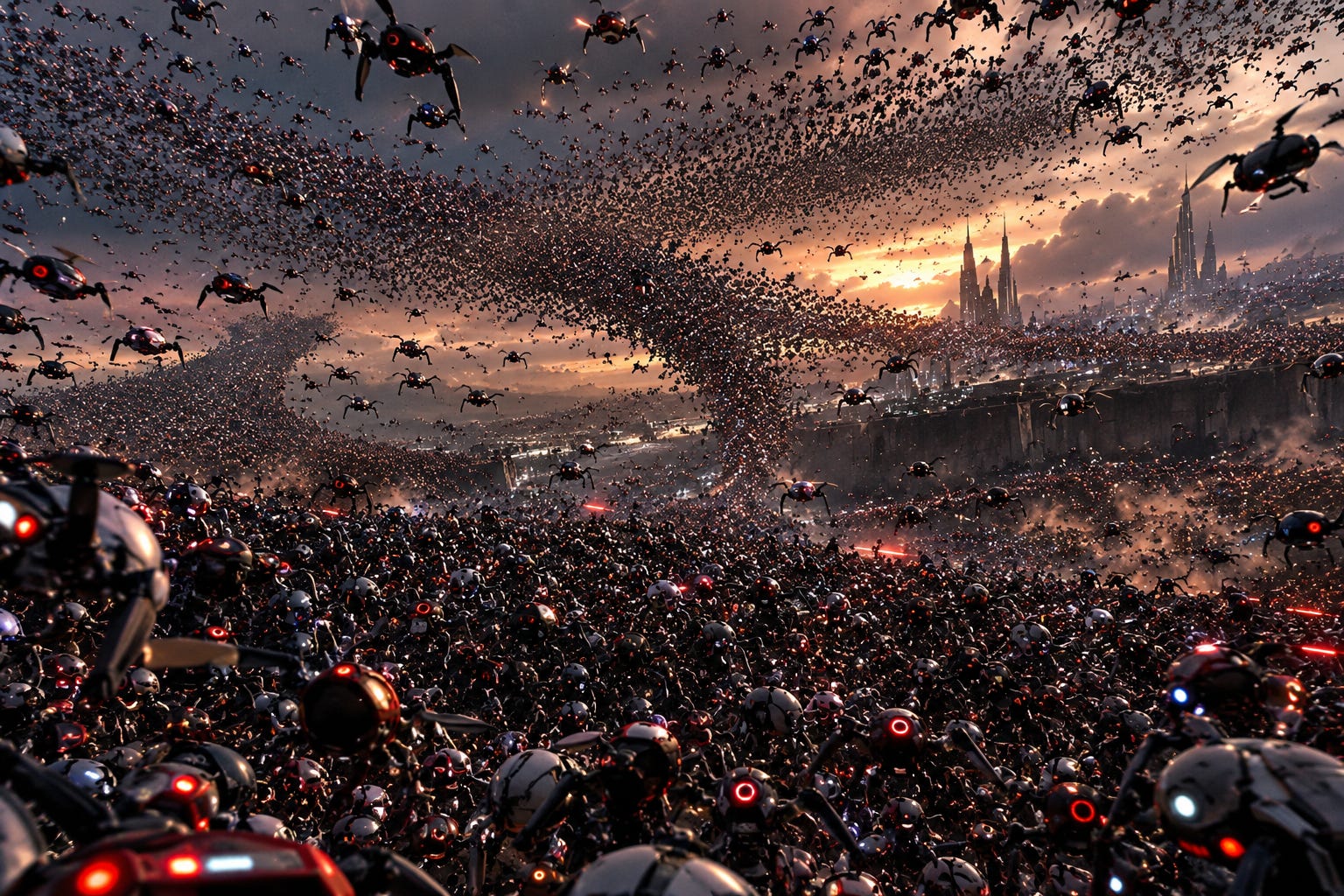
That is basically an agent swarm.
It isn’t necessarily one super-intelligent AI. It could be thousands of agents searching different places, using different tools, trying different approaches and sharing what they learn.
This becomes particularly interesting because a lot of security is really information asymmetry.
You don’t know what I know. You don’t know an old system is still online. You don’t know about an undocumented endpoint. You don’t know someone misconfigured something five years ago. Individually, none of these discoveries may matter much. Put enough of them together and you may suddenly have a way into a system.
Now replace the humans with software.
That is where scale starts becoming scary.
But the same principle can be incredibly useful. Take jobs and opportunities for example.
There are millions of opportunities on the internet that most people will never find. One is on a company website. Another is in some terrible government portal. Someone mentions another in a LinkedIn post. Another exists in a university system. Another is buried inside some proprietary database.
No single database has everything.
But what if one agent knows how to search Workday. Another understands government websites. Another searches company career pages. Another searches professional networks. Another knows an obscure job board. Another has access to a private dataset.
And they share what they know.
You don’t necessarily need the world’s largest job database anymore.
You need a swarm that knows where to look.
That is part of what we are thinking about with HelloCV AI.
But there is another part of swarms that I think is just as important: cost.
Imagine trying to assemble 100,000 researchers to investigate something for you. Forget salaries for a moment. Just coordinating them would probably be impossible.
Software changes that equation.
Suppose an agent can perform a small piece of research for 10 cents. Running 10 agents costs you $1. Running 1,000 costs $100. Running 100,000 costs $10,000.
Those are illustrative numbers, and the actual cost depends heavily on the model, how long it works and which tools it uses. But this is the important point: intelligence is becoming something you can parallelize by spending more compute.
A company can essentially ask: how much intelligence do we want to throw at this problem?
$10?
$1,000?
$100,000?
That is a very different world.
We have done this before with technology.
We cascaded storage. We pooled memory. We connected computers into clusters. We built distributed databases and giant data centres.
Now we are beginning to cascade reasoning.
One agent searches. Another checks. Another tries a different route. Another remembers what worked before. Another combines everything they found.
And as the cost of inference keeps falling, the number of agents you can economically throw at a problem keeps rising.
That is why I think swarms matter.
The question will increasingly not just be, how smart is the AI?
It will be: how many of them can you deploy, what can they access, what can they share, and how much are you willing to spend?
That can be used to find a vulnerability.
Or a drug.
Or a person.
Or a new job opportunity.
Agent swarms are real. The economics are what will make them everywhere.